~/jeffreymoro/blog/2026-03-21-sick-day
I write to you, dear reader, ensconced in only the finest of Ikea-branded blankets, Vitmossas and Lapptågs alike, sinking deeper into the right angle of my chaise couch, a cardboard box filled with tissues on the ground below me (best to keep the powder room wastebaskets in the power rooms), sick – as the poets say – as a dog. I have been overdue for a good wallopping. There are worse ways to spend the back half of my spring break than going a few rounds with the Jake LaMotta of rhinoviruses. It gives me time, after all, to catch up on my correspondence (blogging).
Professional news: I spent the earlier part of the week, during which my current ailments were but a twinkle in my soft palate, up at the University of Pennsylvania’s Weitzman School of Design for the book launch of Media Matters in Landscape Architecture, an edited volume in which I contributed a chapter on weather stations. My hosts were most gracious and the conversation stimulating: I always especially appreciate the opportunity to spend time in fields and institutional configurations that are far-flung from my own. Here’s a page from the book:
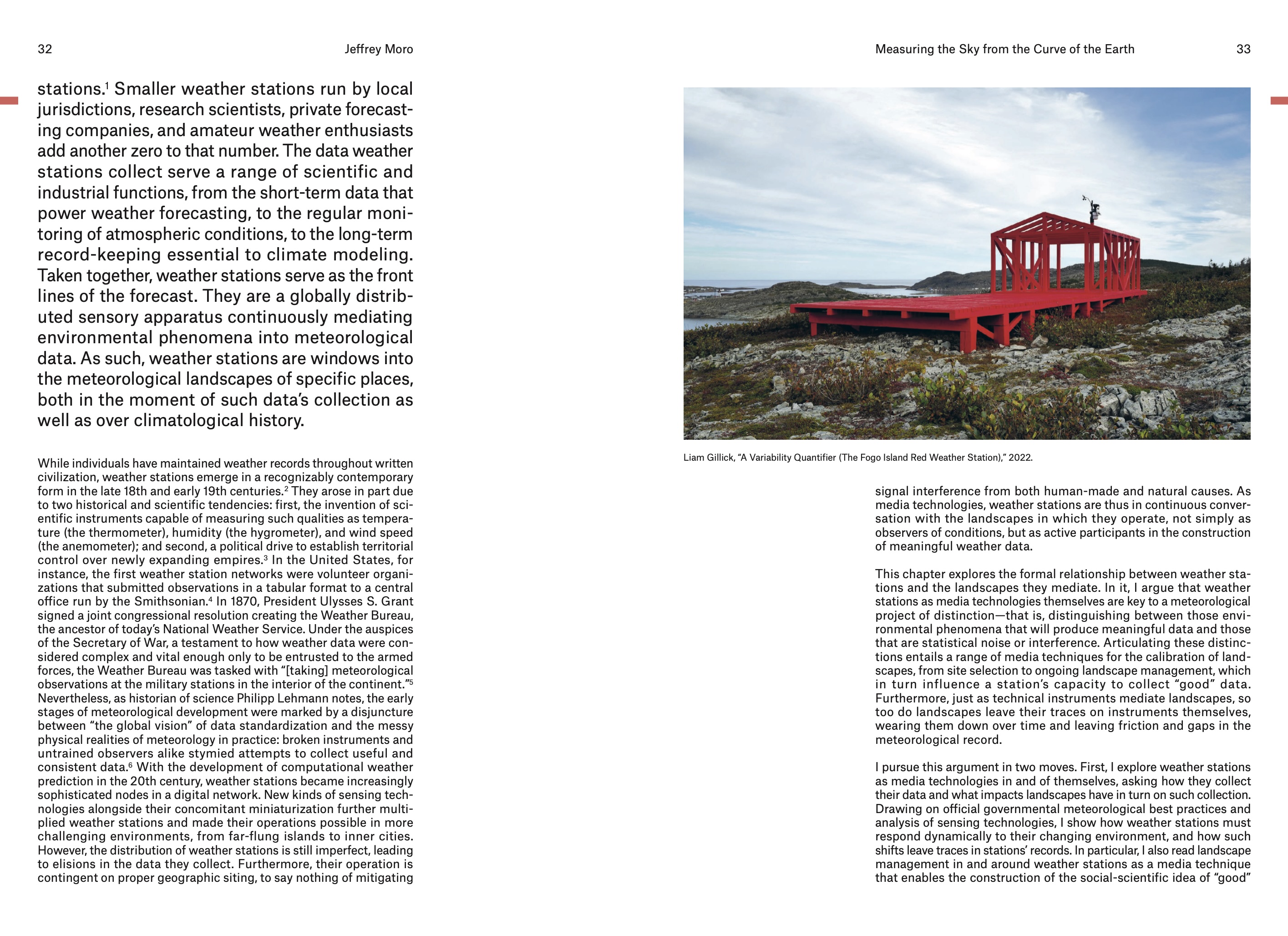
A few more notes for this sick day feuilleton. Last night I watched The Core starring Aaron Eckhart and Hillary Swank. I love this terrible, stupid film. The basic premise is that the Earth’s core stops rotating and its electromagnetic field collapses, leading to various natural disasters including lightning blowing up the Coliseum and UV rays melting the Golden Gate Bridge. Eckhart plays a college professor in geophysics or something of the like – it doesn’t matter – who gets swept up in a plan to tunnel down into the Earth’s core with Stanley Tucci (rival scientist) in a ship made of unobtanium (yes, they call it that, six years before Avatar, suck it James Cameron) piloted by astronaut Swank in order to restart its motion with ten-or-so-thousand kilotons of nuclear weaponry. To paraphrase Brian Cox, this is not a serious film. Nor does it need to be! Practically no part of The Core, from the writing to the performances to the effects, is “well made.” The dialogue is hokey, the acting hammier than a deli sandwich, the pacing plot structure – whatever, you don’t care, you’re here for Stanley Tucci, who, after a scene articulating the impossibility of tunneling down into the Earth’s core, turns to the camera and, after a pause into which you could pilot an F-35 bomber (made of unobtanium), asks: “But what if we could?” Bring back big dumb fun!
This all being said I only watched about thirty percent of The Core because simultaneously I was playing Pokémon Polished Crystal, a fan-made hack of the 2000 game Pokémon Crystal. I have been getting lightly obsessed with the Pokémon romhacking scene over the past few years, both personally and professionally, to the mild concern of all those around me. Personally, I am one of those pre-middle-aged Pokémon fans who – while I will not go so far as to say that the current games are bad, because I am a responsible critic who understands that tastes change and that works, especially those that span decades, must be judged by what they attempt to do in the contexts of their times and not according to an arbitrary yard-stick imported from the past – but who nevertheless recognizes that the current games are, well, Not For Me. Nor is my affection for the old games simply one of nostalgia. (This is where my professional interests come to bear.) I would contend that Pokémon, as a series, has changed over time not simply in scope or graphics but moreover in genre. (I might flesh this out in a later post so please bear with scraps and notes at this juncture.) The earliest games, the ones for the Gameboy and the Gameboy Color, were not yet the monster-collecting-and-battling games that they are today. Rather, they are solidly JRPGs, Japanese role-playing games in the mold of Dragon Quest or Final Fantasy, with similar dungeon-crawling and plot-progression beats. It was only with subsequent revisions to the series – and, crucially, the jump from 2D to 3D – that the games became fully about the pocket monsters themselves. It’s this genre shift that I would suggest is the biggest change in the series, a contradiction that’s proven nigh-impossible for its developers to sublate while maintaining many of the characteristics required by modern big-budget video gaming. (Yes, Virginia, the real villain was capitalism all along.)
Briefly on Polished Crystal: it’s great fun, highly recommend thus far. The hack has been in development for over a decade now and it’s a genuinely impressive work of programming. Its developers have managed to revise, within the contours of the original Gameboy Color programming, the original game to significantly improve on many of its technical systems (e.g., Pokémon management, the Pokédex, etc.) while maintaining precisely that JRPG genre mode that distinguishes the old games from their newer counterparts. More perhaps on this after I finish the game: right now I’m about to go up against that ancient millennial foe: Whitney’s Miltank.
What else. I am reading Moby-Dick again. I have little to say about it right now other than: whales rock. I am reading it for two reasons: first, because it’s fun and I like it and that’s all you really need but also; second, I locked down my phone to the point of removing its web browser because I was sick of doomscrolling about the war with Iran, so now basically the only thing I can do with my phone is check my email and read the only epub on it, which is, yes, you guessed it, say it with me now: Whales Rock. Turning your phone into a single-use device, the use of which is reading one of the great classics of American literature? Another highly recommended, folks.
Okay that is about all I have in me for the morning. Inside me right now are two wolves (naproxen and acetaminophen) warring for dominance, and far be it for me to stop them. Duran? Duran.